Emery Wenger: Learning to Process the Process
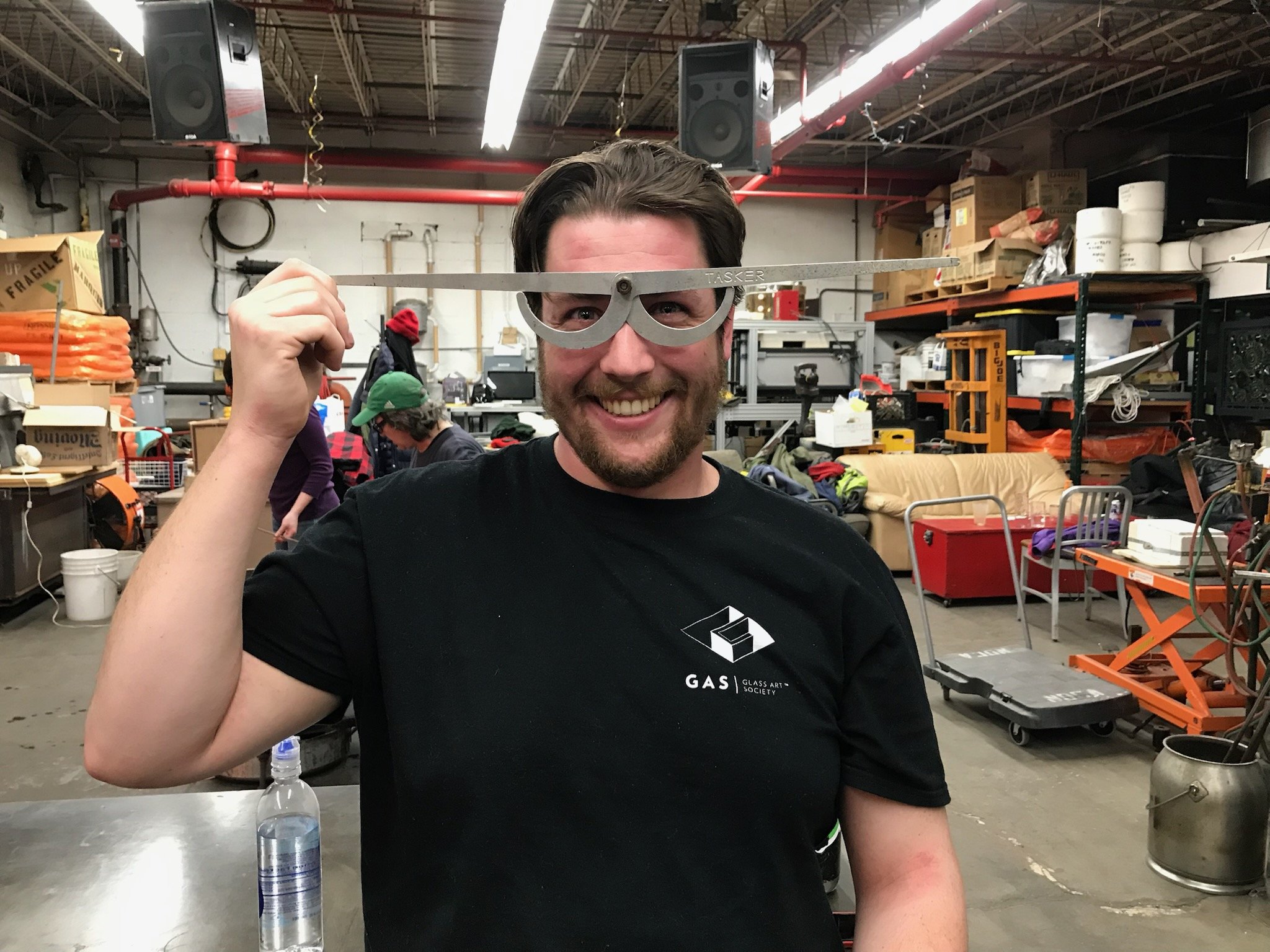
Emery Wenger is a NOCA Glass School instructor and owner of Emery Wenger Glass. He has been working at Almost Perfect Glass (APG) for Andy Magdanz in North Cambridge for fourteen years as a glassblower and assistant and currently divides his time between advancing his artistic practice, expanding NOCA Glass School’s capabilities, and teaching. As a founding member of Greater Boston Glassworks, he looks forward to continuing his teaching, his creative process, and serving as technical support at Greater Boston Glassworks.
Kristin Imre, one of the cofounders of Greater Boston Glassworks, and Emery sat down for a chat one afternoon during a break he took from plumbing new torches for the NOCA Flameshop.
How did you discover glass?
My aunt is a really good bead maker. I went out and hung out with her and did flameworking in Wisconsin. Then in middle school I got a mapgas [a handheld torch] in my garage—it was basically a butane burner—and I made beads.
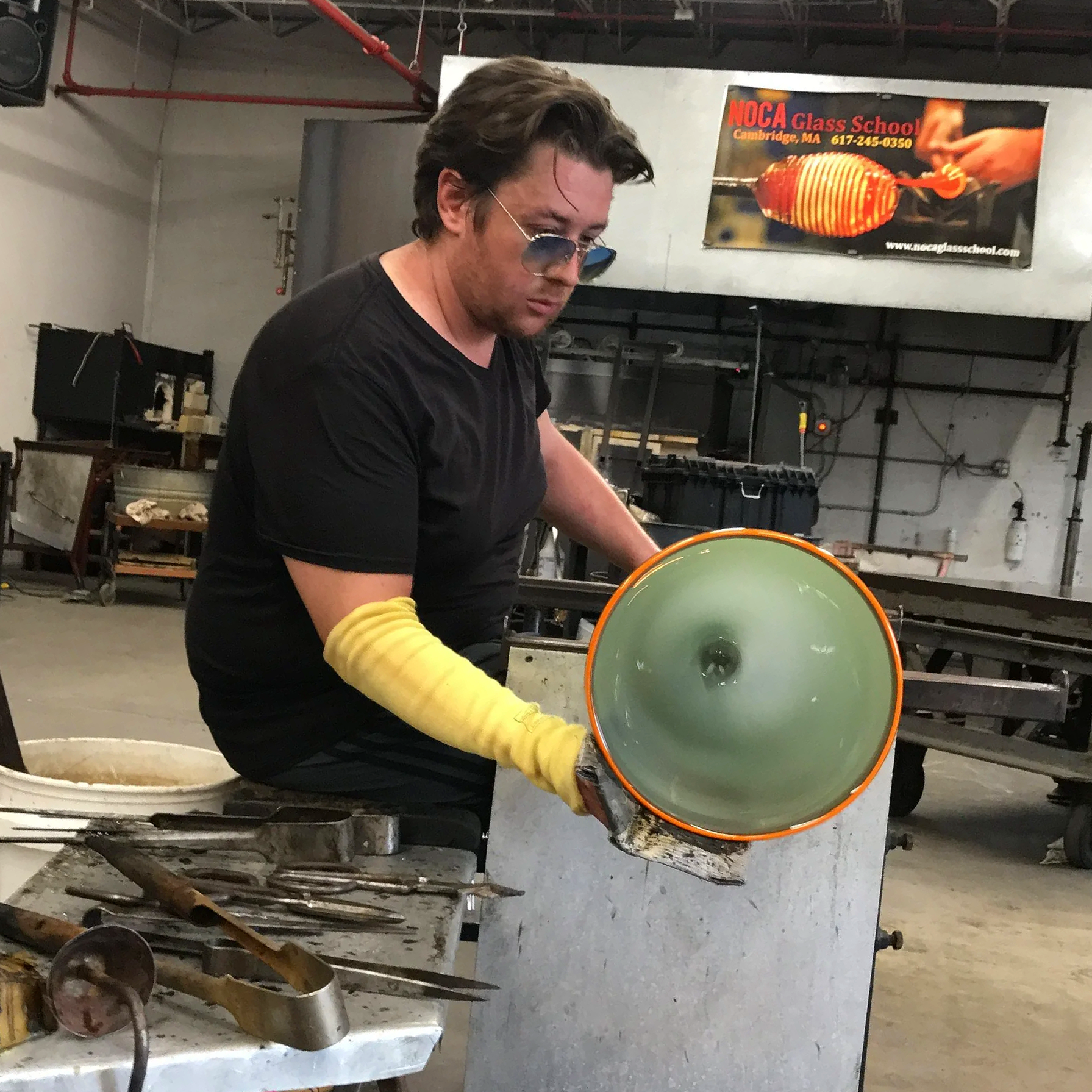
Emery working on one of his signature big bowls
Later, I did a class at RISD [Rhode Island School of Design]—like the weekend glassblowing workshops that NOCA offers. I went with my dad and just totally fell in love with it.
You are now primarily a furnace worker or glass blower. What led you to choose furnace working?
I like the team aspect and the physicality.
Could you say more about why the team aspect appeals to you?
Mental Health, if I am being perfectly honest. I am an only child. I crave human interaction and friends. The social aspect of blowing glass—there are three benches [in the APG hot shop]. There are six people out there all the time. You are never just by yourself and undirected.
And the physicality?
The physical aspect of doing it is a means for me to process the process.
I can lay in bed and think about how to make a shape, but it doesn’t stick until I am touching the glass.
The thinking is in your body. The process is in your body.
Totally. When I was working with a student yesterday, we were trying to figure out how to improve her starter bubble for an optic twist cup. I told her she was rushing at all the wrong times and then having a really hard time being on center. She needed to, we all need to, find the rhythm. The 1 2 3 1 2 3 [said with a waltzing lilt] of getting glass out of the furnace. The rhythm at the marver: you wait. . .you wait. . .you roll. . .you roll. . .you’re off. . .your bubble.
It is that waltz timing.
For the longest time, I was frenetic when I blew glass. I didn’t get it. But, glass is a flowing liquid. You have to flow. You have to let it flow.
Who is the mentor who brought you to your practice?
I guess the real answer is there are a lot of people.
Most of my professors through college including Al [Alan Klein, former head of the MassArt Glass Program] and the community at MassArt. I graduated with Wil Sideman, who is running the Martha’s Vineyard Glassworks. I worked with Dan Sherman, Joey Huang, and Evan Vobel a lot. We spent a lot of time figuring out how to do things together.
Then Jesse Rasid [the former owner of NOCA Glass School] and Dan Battat [a flameworker and educator based in Holyoke, MA]—the only reason I ended up working for Jesse at NOCA Glass School is that Dan got me flameworking with him at Snow Farm [The New England Craft Program in Williamsburg, MA] and Jesse saw how interested I was in glassblowing and teaching.
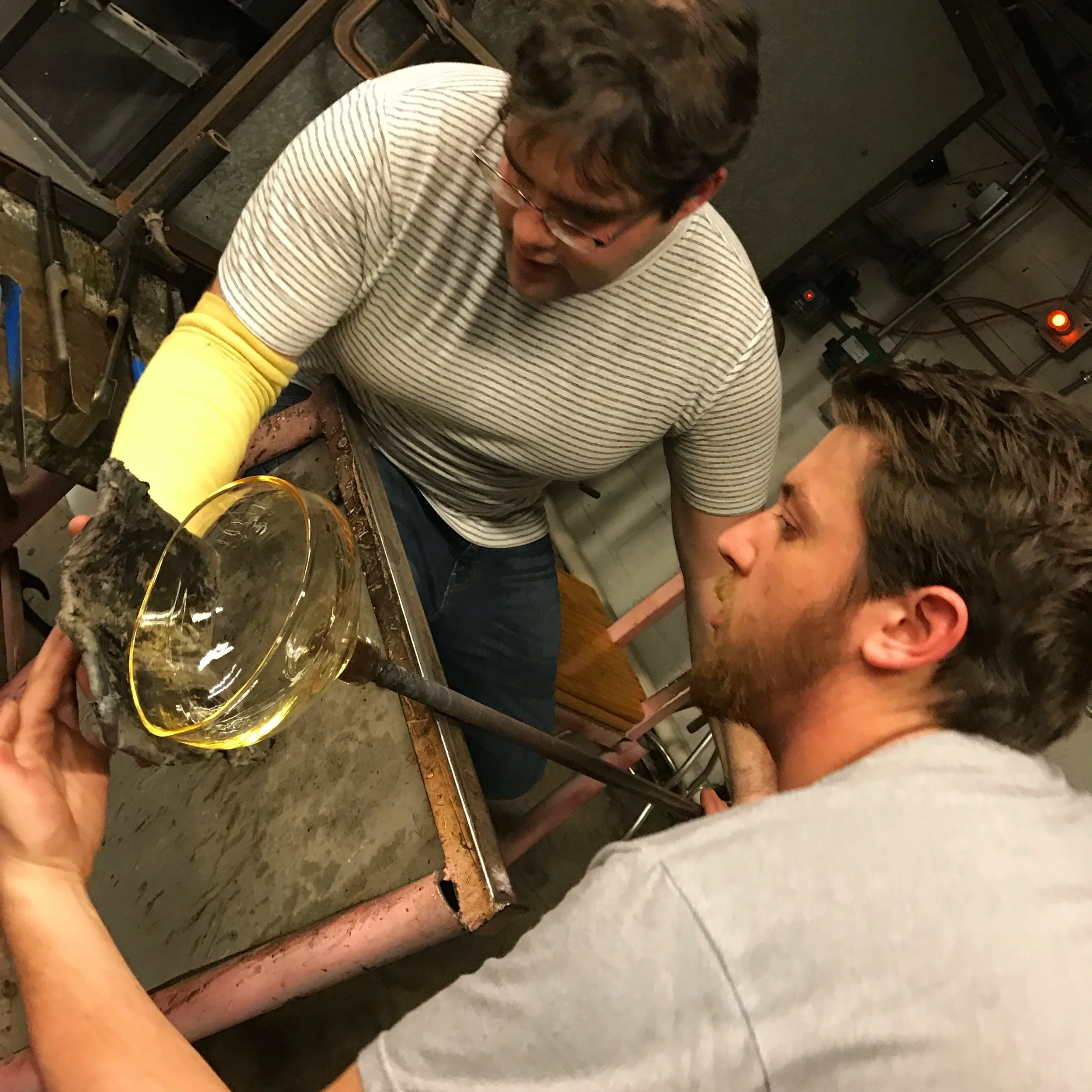
Emery being a stellar glassblowing instructor
What keeps you teaching and making glass
When teaching, the moment or moments that always get me are those moments when you feel like you got a breakthrough with a student just from rewording or explaining things. All of a sudden it clicks and you’re like YES! For teaching moments, that is the apex.
On the other hand, finding that yourself—
You mean those moments when you wake up in your ability.
Yes. You, Kristin, like this part of it: the emotional learning curve. Especially when you are at the level we are at—as far as blowers go—a lot of what makes things click is being more selfless with the medium.
Yeah, I like to say that you are in a conversation with the glass. You listen and watch and then respond. It is much more relational.
Yeah, because it is a liquid and not a solid. You negotiate with liquids. You manipulate solids. You’re influencing how it moves, not dictating.
The creativity of my own practice also keeps me making glass. It comes in intermittent jumps, but when you have an idea and after like two years you have time to do it and it works. It’s like a really rewarding situation. Then when it comes out of the annealer and people are like, that’s cool. It is such a great feeling.
Also, all of my friends are here.
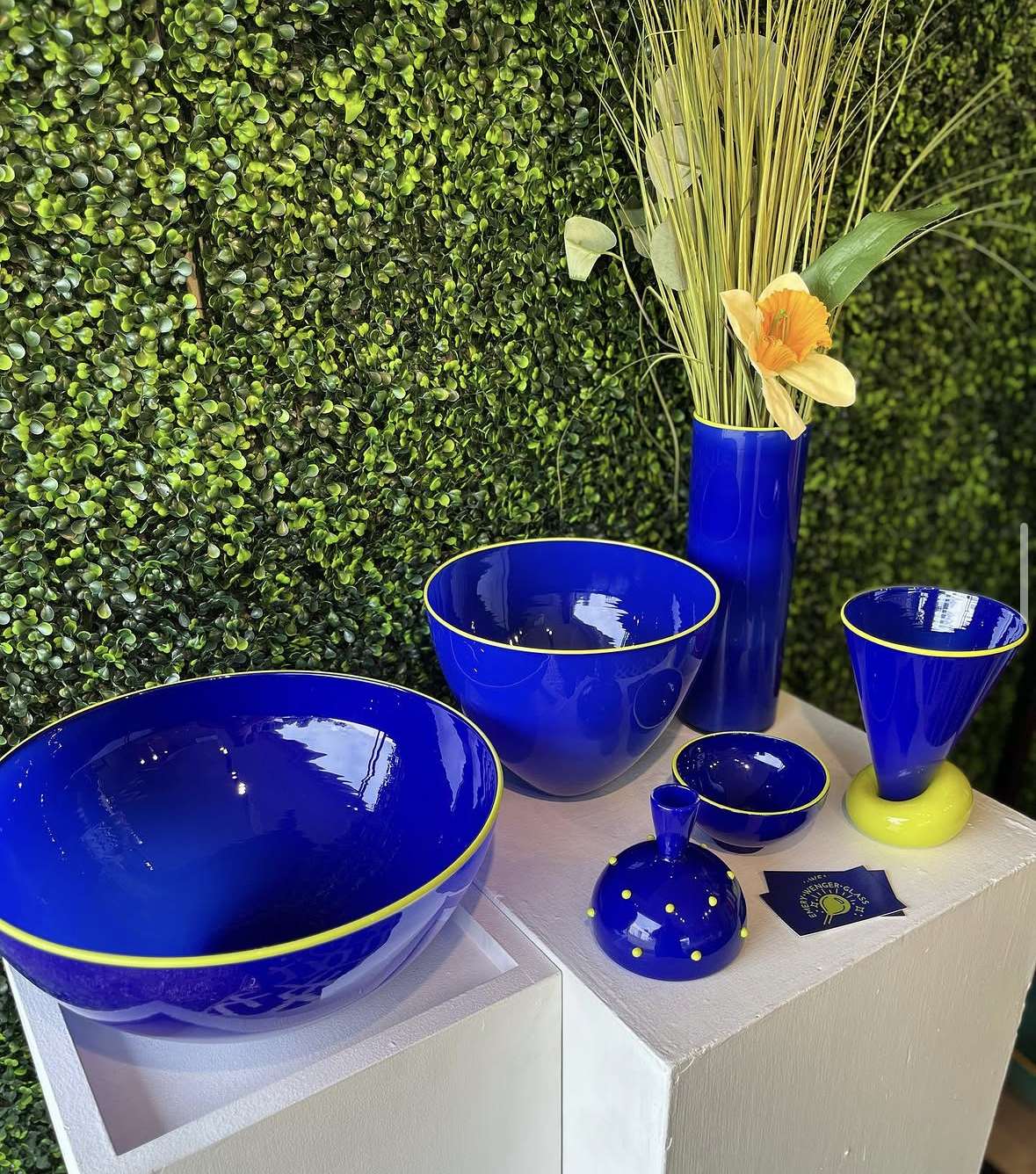
Emery’s production work that is sold nation-wide
What are you looking forward to with GBG?
Making this community more accessible to more people.
It would be cool if we could have a kid in here who could see how they could also build a career and life in glass.
We could be the respected institution that makes a larger community space so more people can have access to this craft.
I mean there are so many good teachers here.
There are so many excellent glassblowers here, but everyone is really an excellent teacher. I think because we have the autonomy to teach the way we teach.
My teaching style is so different from DJ Benyosef’s is so different than Shannon Floyd’s, but we are all making really good glassblowers.
I’ve learned a lot teaching with you, Kristin, because your teaching style is so different from mine. The same way we all learn a lot and got really good because we are all working on different stuff and when we are all working on different stuff you know there are like five brains processing. Imagine opening that up to college age students. There would be so much more to learn.
We have so many established artists and educators who are good at what they do and who have gotten to watch teachers from all over the world like Boyd Sugiki and Lisa Zerkowitz and Davide Fuin and Russel Carson.
Everyone is invested in everyone else having success. I am excited for what we can do with that.